

The Win-Win Workplace™ Co-Lab with CLO LIFT
Leveraging Learning as a Competitive Strategy
By Angela Jackson
Overview
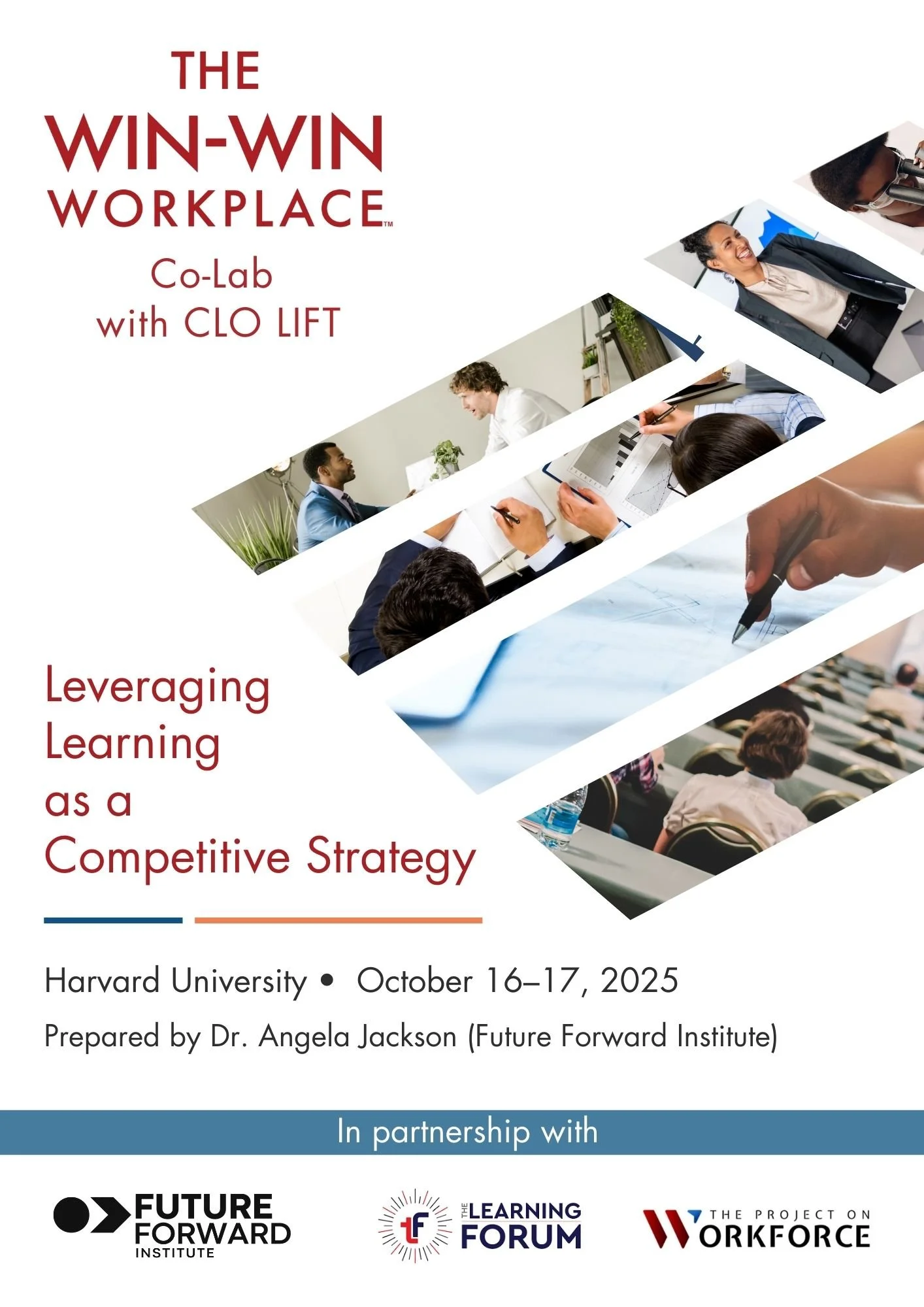
The Win-Win Workplace™ Co-Lab report captures insights from a 2025 convening at Harvard University that brought together Chief Learning Officers, CHROs, senior talent leaders, and researchers to examine how learning can become strategic infrastructure and a measurable driver of business performance in an AI-accelerated environment. The report synthesizes practitioner discussions, pre-survey findings, and research perspectives into a clear view of how the learning function and the CLO role are evolving.
Key Insights
Learning is shifting from a support function to core enterprise infrastructure.
The CLO role is evolving from program oversight to system-level leadership and capability architecture.
Manager capability sits at the center of culture, performance, and execution.
Human and AI capability must be designed as an integrated system.
The field needs shared standards and better ways to measure learning’s impact on business outcomes.
Why This Report Matters
Organizations are under growing pressure to adapt faster, reskill at scale, and perform in an AI-enabled, hybrid, and highly competitive environment. Yet many learning and talent strategies remain disconnected from business strategy and day-to-day execution. This report provides leaders with a research-informed, practitioner-grounded framework for rethinking learning as a core part of how organizations build capability, strengthen culture, and drive performance.
What You’ll Find in the Report
A synthesis of insights from senior learning and talent leaders across industries
Findings from the pre-survey of Co-Lab participants on priorities, gaps, and challenges
Analysis of how the CLO role and learning function are changing in the age of AI
Practical implications for designing learning as part of organizational infrastructure
A forward-looking agenda for strengthening the learning field and its impact on business performance
Beyond the Title
Executive Career Progression Through an Intersectional Inclusion Lens
By Angela Jackson and Kyle Albert

Overview
Executive advancement is often framed as a question of talent, readiness, or representation. Yet new research from the Future Forward Institute reveals a deeper issue: how advancement systems are designed—and for whom they work.
Beyond the Title examines executive career progression through an intersectional inclusion lens, focusing on how leaders experience opportunity, risk, and trust once they reach senior levels. Drawing on data from the 2024–2025 Win-Win Workplace™ Sentiment Study, the report shows that representation alone is insufficient. When advancement systems rely on informal networks, opaque criteria, and discretionary decision-making, confidence in progression erodes—even among high-performing leaders.
Importantly, the findings demonstrate that when organizations design advancement systems to work for leaders facing the greatest structural barriers, those systems become clearer, fairer, and more effective for everyone.
Key Insights
Career optimism among executives is declining, signaling breakdowns in advancement systems rather than disengagement or lack of ambition.
Representation does not equal opportunity—many leaders report reduced confidence in advancement once they reach senior roles.
Psychological safety often narrows at the top, particularly as visibility and risk increase.
Sponsorship is a decisive factor in executive advancement, yet access remains uneven.
Executive sentiment functions as a leading indicator, surfacing system failures before attrition or performance declines become visible.
Why This Report Matters
Organizations invest heavily in leadership pipelines, yet many struggle to sustain diverse executive talent over time. This report reframes the challenge: the issue is not who leaders are, but how advancement systems function.
By centering the experiences of leaders navigating intersecting identities, Beyond the Title surfaces early signals of where inclusion is breaking down—and offers a roadmap for redesigning advancement systems to unlock human potential, strengthen leadership capacity, and improve long-term organizational performance.
What You’ll Find in the Report
A clear explanation of executive advancement through an intersectional inclusion lens
Analysis of trends from the 2024–2025 Win-Win Workplace™ Sentiment Study
Practical implications for leaders designing advancement systems for the whole employee
The Competitive Advantage of the

By Angela Jackson, Kyle Albert, Olivia Gunther, Ashley Yuan and Guy Berger
Discover innovative strategies and how they correlate with positive financial outcomes that benefit workers and unlock shareholder value.
Background
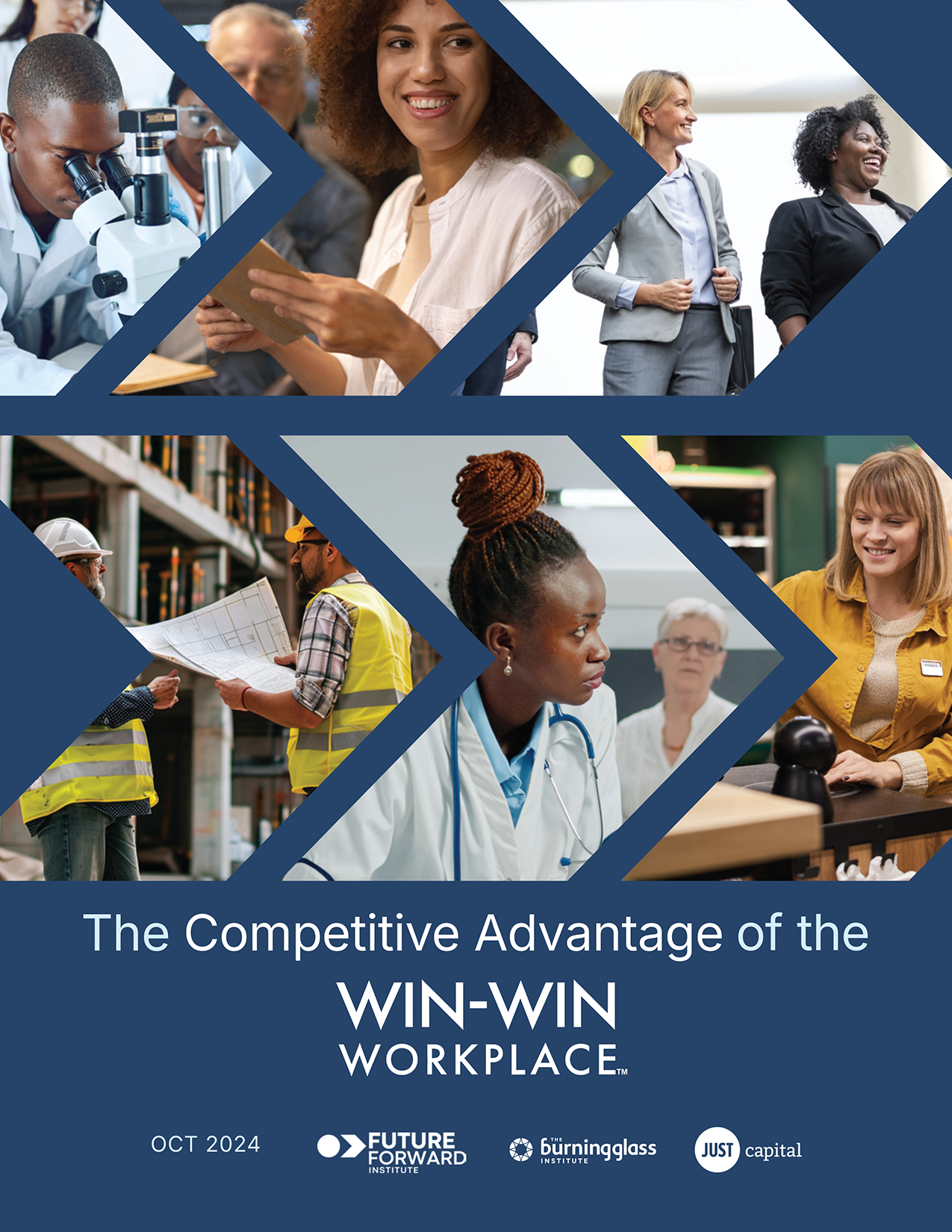
The Win-Win Workplace™ framework represents a set of nine worker-centered, equity-first strategies identified through research to elevate both employees and companies. The purpose of this report is to demonstrate how businesses that prioritize their workers, through thoughtful practices and policies, can achieve superior financial performance while fostering a healthier, more inclusive work environment.
The Future Forward Institute, in collaboration with Burning Glass Institute and JUST Capital, conducted a comprehensive study that links employee-centered practices with measurable business success. This report aims to shed light on how employers can create a thriving workplace that benefits both employees and the company’s bottom line.
The Full Report
This research draws from a range of data sources, including American Opportunity Index from Burning Glass Institute and JUST Capital, to track firm performance across metrics such as employee benefits, retention, and mobility. This report also reveals that firms adopting win-win workplace strategies experience higher revenue growth, improved profitability, and enhanced employee satisfaction.
The Press Release
With key findings showing significant correlations between employee thriving and financial success, this report offers actionable insights for companies aiming to drive sustainable growth through a people-first approach. The release of The Competitive Advantage of the Win-Win Workplace™ underscores the urgency for companies to adopt human-centered strategies.

View our report on the practices that differentiate workplaces that are attuned to employee growth and development.
Press Release
Discover how your company can drive sustainable growth through a people-first approach
The Top Takeaways

The future demands a new approach:
Traditional workplace models no longer support thriving employees. To stay competitive, businesses must prioritize employee well-being. Companies that center employee voices and inclusivity see gains in profits, revenue, and asset validation.

Business leaders who act now will reap rewards:
Leaders can take three key steps:
Deepen Understanding of Worker Voice
Reframe Through a Worker Lens
Position CEO and Frontline Leaders as Champions

More Data is Needed:
While initial findings are promising, more transparency and research are required to fully understand the benefits of worker-centered practices
News
& Press
Have a media inquiry?
Our media kit contains additional assets and statistics.
Need more info?
Please reach out to us and we’re more than happy to provide additional assets and information.